Showing posts with label RIO DE JANEIRO. Show all posts
Showing posts with label RIO DE JANEIRO. Show all posts
Saturday, 7 August 2010

Wednesday, 17 February 2010
Jornal do Brasil - Carnaval 2010 - Unidos da Tijuca vence o Carnaval depois de 74 anos
Jornal do Brasil - Carnaval 2010 - Unidos da Tijuca vence o Carnaval depois de 74 anos
Source by Jornal do Brasil and Globo Vidios - G1


Tuesday, 16 February 2010
Monday, 15 February 2010
History of Carnival in Brazil

The origins of carnival date back to the ancient Greek spring festival in honor of Dionysus, the god of wine. The Romans adopted the celebration with Bacchanalia (feasts in honor of Bacchus, the Roman equivalent to Dionysus), and Saturnalia, where slaves and their masters would exchange clothes in a day of drunken revelry. Saturnalia was later modified by the Roman Catholic Church into a festival leading up Ash Wednesday. It quickly evolved into a massive celebration of indulgences - one last gasp of music, food, alcohol, and sex before Lent - before the 40 days of personal reflection, abstinence, and fasting until Easter (not exactly what the Church probably had in mind). 40 days of purging sins, preceded by a week filled with virtually every known sin. The word itself comes from Latin, "Carne Vale" or "Farewell to the Flesh".
Brazil - Rio de Janeiro
Rio's lavish carnival is one of the world's most famous. Scores of spectacular floats surrounded by thousands and thousands of dancers, singers, and drummers parade through the enormous Sambódromo Stadium dressed in elaborate costumes (or, quite often, with absolutely no costume.) It is an epic event televised around the world. The origin of Brazil's carnival goes back to a Portuguese pre-lent festivity called "entrudo", a chaotic event where participants threw mud, water, and food at each other in a street event that often led to riots (an event quite similar to today's Andean carnival - see Venezuelan section of this booklet). Rio's first masquerade carnival ball (set to polkas and waltzes) was in 1840. Carnival street parades followed a decade later with horse drawn floats and military bands. The sound closely associated with the Brazilian carnival, the samba, wasn't part of carnival until 1917. The samba is a mix of Angolan semba, European polka, African batuques, with touches of Cuban habanera and other styles. What we now know as samba is a result of the arrival of black Brazilians (primarily from Bahia) to the impoverished slums or favelas surrounding Rio following the abolition of slavery in Brazil in 1888.
Today the carnival is organized by the escolas de samba (samba schools). They first appeared in 1928. Much more than musical groups, they are in fact, neighborhood associations that provide a variety of community needs (such as educational and health care resources) in a country with grinding poverty and no social safety net.
Brazil - Salvador da Bahia
Salvador da Bahia was Brazil's first center of government (from 1549 to 1763), and remains its musical capital. For centuries, Bahia was home of the Portuguese sugar industry and slave trade. As a result, today Salvador is the largest center of African culture in the Americas. Amidst the colonial architecture and cobblestone streets, there is an unmistakeable beat of Bahian drumming. You can hear it in the stereo speakers and boomboxes blasting the latest Axê pop music. It becomes overwhelming when the large percussion ensembles (with literally hundreds of drummers) called "blocos Afros" take to the streets for carnival. It was a movement launched a half century ago by the group, Filhos de Gandhi (Sons of Gandhi). Today, there are countless blocos Afros that have taken on a new mission as part of the "negritude" movement to re-establish Black Pride. Olodum, Ara Ketu, Ilê Aiyé, Timbalada and the all women's drumming mega-group Dida all electrify Salvador every February during carnival. Olodum's Billy Arquimimo explains, "We started Olodum 20 years ago because at that time, black people used to be ashamed of their skin. We thought it was necessary to do something to re-establish Black Pride, and to redevelop African culture here in Bahia."
Like Rio, the city of Salvador is famous for its carnival. For both cities, it is an enormous festival leading up to Lent. That is where the similarities end. Rio is famous for its Samba schools, elaborate costumes (or at times no costumes), and a huge parade held at the Sambódromo Stadium. Salvador is Brazil's street carnival. It lasts for weeks. The music begins daily as early as noon and runs until 7 or 8 the next morning.
Bahian superstar Carlinhos Brown explains, "We play, not for money, but to celebrate happiness. Our carnival is a street carnival. It is for everyone, not just for those with money." In addition to the Blocos Afros, artists like Carlinhos Brown and Daniela Mercury perform on huge trucks, packed with loudspeakers called "trio electricos". These are the big tractor-trailer trucks packed with huge speakers. The tradition began in 1950 when two Bahian musicians, Dodo and Osmar, performed with their electric trio aboard a 1929 Ford pickup truck.. Even though there are regularly 20-40 bandmembers atop 18 wheeler mega-trucks today, the name "trio electrico" still sticks. Bahia's carnival is perhaps the world's largest public festivity, attracting crowds of three million that dance through the night in Salvador's historic colonial streets.
Source by Dan Rosenberg e NatiLight68 (youtube)
Sunday, 14 February 2010
Brazilian Carnival - Rio de Janeiro style -
Modern Brazilian Carnival originated in Rio de Janeiro in 1641, when the city's bourgeoisie imported the practice of holding balls and masquerade parties from Paris. It originally mimicked the European form of the festival, later absorbing and creolizing elements derived from Native American and African cultures.
In the late 19th century, the cordões (literally laces or strings in Portuguese) were introduced in Rio de Janeiro. These were pageant groups that paraded through city avenues performing on instruments and dancing. Today they are known as Blocos (blocks), consisting of a group of people who dress in costumes or special t-shirts with themes and/or logos. Blocos are generally associated with particular neighborhoods; they include both a percussion or music group and an entourage of revellers.
Block parades have become an expressive feature of Rio's Carnival. Today, they number more than 100 and the groups increase each year. Blocos can be formed by small or large groups of revelers with a distinct title with a often funny pun. They may also note their neighborhood or social status. Before the show, they gather in a square, then parade in sections of the city, often near the beach. Some blocos never leave one street and have a particular place, such as a bar, to attract viewers. Bloc parades start in January, and may last until the Sunday after Carnival.
Blocos parade in nearly every neighborhood, but the most famous ones parade in Copacabana, Ipanema, Leblon, Lagoa, Jardim Botânico, and in downtown Rio. Organizers often compose their own music themes that are added to the performance and singing of classic "marchinhas" and samba popular songs. "Cordão do bola preta" ("Polka Dot Bloco"), that goes through the heart of Rio's historical center, and "Suvaco do Cristo" (Christ's statue armpit, referring to the angle of the statue seen from the neighborhood), near the Botanical Garden, are some of the most famous groups. Monobloco has become so famous that it plays all year round at parties and small concerts.
Samba schools are very large groups of performers, financed by respected organizations (as well as illegal gambling groups), who work year round in preparation for Carnival. Samba Schools perform in the Sambadrome, which runs four entire nights. They are part of an official competition, divided into seven divisions, in which a single school is declared the winner, according to costume, flow, theme, and band music quality and performance. Some samba schools also hold street parties in their neighborhoods, through which they parade along with their followers."
Source by Wikipedia, Globo Videos,
In the late 19th century, the cordões (literally laces or strings in Portuguese) were introduced in Rio de Janeiro. These were pageant groups that paraded through city avenues performing on instruments and dancing. Today they are known as Blocos (blocks), consisting of a group of people who dress in costumes or special t-shirts with themes and/or logos. Blocos are generally associated with particular neighborhoods; they include both a percussion or music group and an entourage of revellers.
Block parades have become an expressive feature of Rio's Carnival. Today, they number more than 100 and the groups increase each year. Blocos can be formed by small or large groups of revelers with a distinct title with a often funny pun. They may also note their neighborhood or social status. Before the show, they gather in a square, then parade in sections of the city, often near the beach. Some blocos never leave one street and have a particular place, such as a bar, to attract viewers. Bloc parades start in January, and may last until the Sunday after Carnival.
Blocos parade in nearly every neighborhood, but the most famous ones parade in Copacabana, Ipanema, Leblon, Lagoa, Jardim Botânico, and in downtown Rio. Organizers often compose their own music themes that are added to the performance and singing of classic "marchinhas" and samba popular songs. "Cordão do bola preta" ("Polka Dot Bloco"), that goes through the heart of Rio's historical center, and "Suvaco do Cristo" (Christ's statue armpit, referring to the angle of the statue seen from the neighborhood), near the Botanical Garden, are some of the most famous groups. Monobloco has become so famous that it plays all year round at parties and small concerts.
Samba schools are very large groups of performers, financed by respected organizations (as well as illegal gambling groups), who work year round in preparation for Carnival. Samba Schools perform in the Sambadrome, which runs four entire nights. They are part of an official competition, divided into seven divisions, in which a single school is declared the winner, according to costume, flow, theme, and band music quality and performance. Some samba schools also hold street parties in their neighborhoods, through which they parade along with their followers."
Source by Wikipedia, Globo Videos,
Saturday, 13 February 2010
Brazilian Carnival - São Paulo style - 2010
The carnival in São Paulo happens in Anhembi Sambodrome and also has some organized "soccer schools." This is the main difference between São Paulo carnival and Rio. The Carnival parades in São Paulo happen on Friday and Saturday night, as opposed to Rio's Carnival, which is held on Sunday and Monday night.


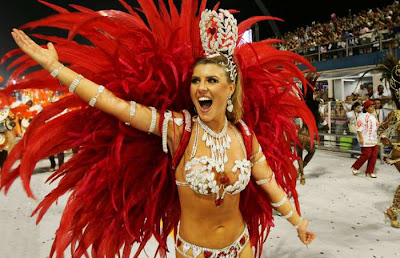


Source by Estadao/Wikipedia/ Carnaval 2010 - TERRA


Source by Estadao/Wikipedia/ Carnaval 2010 - TERRA
Tuesday, 8 December 2009
RIO DE JANEIRO - THE CITY
THE CITY
Rio de Janeiro is truly still beautiful. The City, ever more Marvelous. With its natural beauty, one of the most beautiful seashores in the world, comprised of 14 beaches, the contagious, heartwarming joy of six million inhabitants spread over 159 districts, a unique and highly animated cultural diversity and life, this postcard of Brazil receives the world with open arms.
Rio is Carioca; it is Brazilian; it is international. It is feeling at home even though you live on the other side of the world and do not speak a word of Portuguese.
Rio is festive. The city's cultural fervor is so great that it is common to have events where the turnout exceeds one million people. Some examples of this are the New Year's celebration, Carnaval, sports events such as the 2004 Athens Olympic Torch Relay and rock concerts on the beach, such as Live Earth and the Rolling Stones.
The Marvelous City is enjoyed by illustrious residents, including athletes, artists and intellectuals and it offers diverse leisure options for those who live here or those just passing through, 24 hours a day, 7 days a week. The famous cable car that takes you to the breathtaking view from atop the Sugar Loaf; the adventures of hang gliding; the classic matches at the world symbol for this nation of soccer shoes, Maracanã Stadium; the traditional nightlife of Lapa; the exuberant Marina da Glória; Colombo bakery, the brand of Rio gastronomic value. There are countless leisure options. From the pedal boat rides on the Rodrigo de Freitas Lagoon to the habitual walks along the Copacabana Boardwalk, the Rio resident participates in every activity the city offers. All this under the watchful blessing of Christ the Redeemer, one of the new Seven Wonders of the World.
FRANÇAIS
LA VILLE
Rio de Janeiro continue réellement belle. La Ville, chaque fois plus Merveilleuse. Avec ses beautés naturelles, un des plus beaux bord de mer du monde, formé par 14 plages, la joie contagieuse et chaleureuse de six millions d'habitants occupant 159 quartiers, une diversité et une vie culturelle unique et effervescente, la carte postal du Brésil reçoit le monde les bras ouverts.
Rio c'est Carioca, c'est brésilien, c'est international. C'est se sentir à la maison, même si vous habitez de l'autre côté du globe et ne parlez pas un seul mot de portugais.
Rio c'est la fête. La ferveur culturelle de la ville est si grande qu'il est fréquent que des évènements s'y déroulent en présence de public dépassant le nombre d'un million de personnes, ce qui peut être confirmé au passage de la Nouvelle Année (Réveillon), au Carnaval, au cours d'événements sportifs tel que le relais du Flambeau Olympique d'Athènes 2004 et dans le cas de concerts de rock sur la plage comme ceux de Live Earth et des Rolling Stones.
Fréquentée par d'illustres habitants, entre eux des sportifs, des artistes et des intellectuels, la Ville Merveilleuse offre diverses options de loisir pour ceux qui sont d'ici ou ceux qui sont de passage, 24 heures sur 24, 7 jours par semaine. Le fameux téléphérique qui vous donne une vue extraordinaire du haut du Pain de Sucre; les aventures en deltaplane; les classiques dans le symbole mondial de la patrie des chaussures de foot, le Maracanã; la traditionnelle bohème de la Lapa; l'exubérante Marina de la Glória; la confiserie Colomb, borne de la mise en valeur de la gastronomie Carioca. Ce sont d'innombrables options de loisir. Des promenades en pédalo sur l'Étang Rodrigo de Freitas aux habituelles promenades sur le Trottoir de Copacabana, le Carioca participe à toutes les activités qui la ville offre. Tout ceci sous la bénédiction du Christ Rédempteur, une des nouvelles Sept Merveilles du monde.
SOURCE by.: Canal de hmviana, www.rio2016.com, BrazilView and PrefeituradoRio
Rio de Janeiro is truly still beautiful. The City, ever more Marvelous. With its natural beauty, one of the most beautiful seashores in the world, comprised of 14 beaches, the contagious, heartwarming joy of six million inhabitants spread over 159 districts, a unique and highly animated cultural diversity and life, this postcard of Brazil receives the world with open arms.
Rio is Carioca; it is Brazilian; it is international. It is feeling at home even though you live on the other side of the world and do not speak a word of Portuguese.
Rio is festive. The city's cultural fervor is so great that it is common to have events where the turnout exceeds one million people. Some examples of this are the New Year's celebration, Carnaval, sports events such as the 2004 Athens Olympic Torch Relay and rock concerts on the beach, such as Live Earth and the Rolling Stones.
The Marvelous City is enjoyed by illustrious residents, including athletes, artists and intellectuals and it offers diverse leisure options for those who live here or those just passing through, 24 hours a day, 7 days a week. The famous cable car that takes you to the breathtaking view from atop the Sugar Loaf; the adventures of hang gliding; the classic matches at the world symbol for this nation of soccer shoes, Maracanã Stadium; the traditional nightlife of Lapa; the exuberant Marina da Glória; Colombo bakery, the brand of Rio gastronomic value. There are countless leisure options. From the pedal boat rides on the Rodrigo de Freitas Lagoon to the habitual walks along the Copacabana Boardwalk, the Rio resident participates in every activity the city offers. All this under the watchful blessing of Christ the Redeemer, one of the new Seven Wonders of the World.
FRANÇAIS
LA VILLE
Rio de Janeiro continue réellement belle. La Ville, chaque fois plus Merveilleuse. Avec ses beautés naturelles, un des plus beaux bord de mer du monde, formé par 14 plages, la joie contagieuse et chaleureuse de six millions d'habitants occupant 159 quartiers, une diversité et une vie culturelle unique et effervescente, la carte postal du Brésil reçoit le monde les bras ouverts.
Rio c'est Carioca, c'est brésilien, c'est international. C'est se sentir à la maison, même si vous habitez de l'autre côté du globe et ne parlez pas un seul mot de portugais.
Rio c'est la fête. La ferveur culturelle de la ville est si grande qu'il est fréquent que des évènements s'y déroulent en présence de public dépassant le nombre d'un million de personnes, ce qui peut être confirmé au passage de la Nouvelle Année (Réveillon), au Carnaval, au cours d'événements sportifs tel que le relais du Flambeau Olympique d'Athènes 2004 et dans le cas de concerts de rock sur la plage comme ceux de Live Earth et des Rolling Stones.
Fréquentée par d'illustres habitants, entre eux des sportifs, des artistes et des intellectuels, la Ville Merveilleuse offre diverses options de loisir pour ceux qui sont d'ici ou ceux qui sont de passage, 24 heures sur 24, 7 jours par semaine. Le fameux téléphérique qui vous donne une vue extraordinaire du haut du Pain de Sucre; les aventures en deltaplane; les classiques dans le symbole mondial de la patrie des chaussures de foot, le Maracanã; la traditionnelle bohème de la Lapa; l'exubérante Marina de la Glória; la confiserie Colomb, borne de la mise en valeur de la gastronomie Carioca. Ce sont d'innombrables options de loisir. Des promenades en pédalo sur l'Étang Rodrigo de Freitas aux habituelles promenades sur le Trottoir de Copacabana, le Carioca participe à toutes les activités qui la ville offre. Tout ceci sous la bénédiction du Christ Rédempteur, une des nouvelles Sept Merveilles du monde.
SOURCE by.: Canal de hmviana, www.rio2016.com, BrazilView and PrefeituradoRio
Thursday, 19 February 2009
Subscribe to:
Posts (Atom)